
Which of the following figures represents the variation of particle momentum $p$ and the associated de-Broglie wavelength $\lambda$?
- A
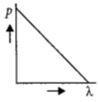
- B
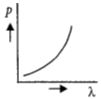
- C
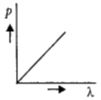
- D
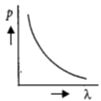
Explore More
Similar Questions
An electron of mass $m$ and charge $e$ initially at rest gets accelerated by a constant electric field $E$. The rate of change of de-Broglie wavelength of the electron at time $t$ is (Ignore relativistic effect) ($h=$ Planck's constant).
The wavelength of light from the spectral emission line of sodium is $589 \; nm$. Find the kinetic energy at which
$(a)$ an electron,and
$(b)$ a neutron,would have the same de Broglie wavelength.
$(a)$ an electron,and
$(b)$ a neutron,would have the same de Broglie wavelength.
Medium
View Solution$A$ charged particle is accelerated from rest through a certain potential difference. The de-Broglie wavelength is $\lambda_1$ when it is accelerated through $V_1$ and is $\lambda_2$ when accelerated through $V_2$. The ratio $\lambda_1 / \lambda_2$ is
$A$ particle of mass $2 \times 10^{-27} \,kg$ has a de-Broglie wavelength of $3.3 \times 10^{-10} \,m$. The kinetic energy of this particle is (Planck's constant $h = 6.6 \times 10^{-34} \,J \cdot s$).
The kinetic energy of an electron having de-Broglie wavelength $\lambda$ is ($h=$ Planck's constant,$m=$ mass of electron).
Vedclass Products
For Students
Vedclass Test Series
Mock tests in real JEE/NEET style with performance analysis. 5-day free trial.
Start Free TrialFor Teachers
Exam Paper Generator
Generate Set A/B/C/D exam papers from 7.5L+ questions in 2 minutes. 3 chapters free.
Try FreeFor Institutes
Online Exam Module
Live online exams with unlimited students, 360° analytics & white-label branding.
See Demo